
What’s the Point?
A hopeful message for soon-to-be lawyers (and everyone else, I guess)

I haven’t had much time for recreational writing, because I haven’t had much time to think about anything. It’s widely known that the decline of a civilization upends countless lives, but you don’t think about the myriad ways in which a life can be upended until it’s yours. Discarding excess weight. Buying dry goods. Making plans for my daughters as they are relegated to the status of livestock in their home state. Planting seeds. Putting stuff in boxes. Doomscrolling. Drinking. All that occupies both time and focus.
And there’s work. Fascism makes everything more expensive, including basic survival, and so there is work, more work, and still more work. More than you can handle, because you dare not turn it away for fear that it may be the last you ever get. Not that I’m complaining; at times like this, it can be nice to escape the world by drowning in labor. But it leaves room for little else, including deeper reflection on how we got here and what happens next. I suppose that’s how the system is designed.
There are moments that lend clarity, though. For example: when grad students sneak into my office after class and ask: “What’s the point of all this?”
It’s a good question. Law school is a lot of work, and it costs a lot of money. Why put yourself through all that when the future looks so bleak? Why pursue a career in rhetoric and persuasion if people in power don’t give two fucks about the meanings of words? Not only that, but isn’t it dangerous to represent people in need, or even to be highly educated, in this time and place? If we continue this trajectory, won’t they send us to the camps along with our clients before too long? Or just kill us? Why be a lawyer in a society that no longer cares about the rule of law?
Hit with the cold water of questions like these, I find myself unable to be sufficiently distracted by the work demon in my ear. I’ll try to answer, but I need a couple of paragraphs.
In the meantime, I offer a different distraction: In central Turkey, there is a museum that houses remnants of the earliest known civilizations. These artifacts tell us a lot about who we are as a species. Statues of fertility goddesses celebrate maternal power. Coinage and weaponry trace the roots of intercultural exchange and conflict. A relief of the Epic of Gilgamesh reminds us of the dangers of hubris, and of our inevitable mortality.
Nestled among these treasures are a series of legal documents carved into stone: a prenuptial agreement, a will, a certificate of debt, a judgment of guilt, and more. As writing goes, these tablets are shockingly old, dating back before Greece and Rome, long before the idea of the West, and long, long before the American Empire. Someone in or around Akkad, who understood the meaning of words and how they might influence the conduct of other people, probably crafted those tablets to aid someone else. Who, five thousand years ago, could have done that?
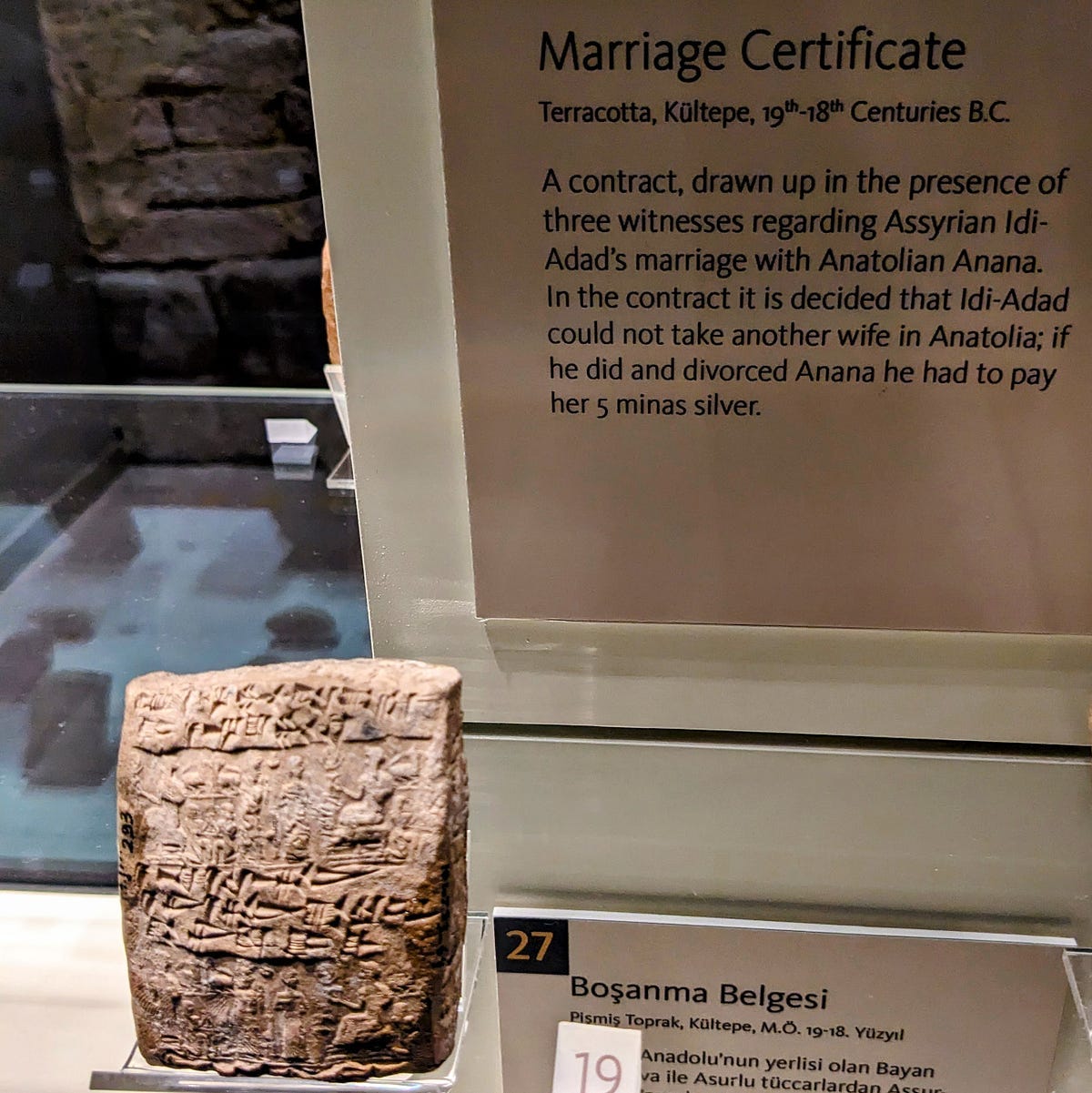
The answer, of course, is: the lawyer. The counselor. The law-talking guy. The advocate. Whatever you call it, it is a timeless archetype. The people who understand the intricacies of statecraft, who make and interpret rules that other people live by, who manufacture the gears of society, and who advise and protect. Like musicians, carpenters, soldiers, and teachers, we have existed as long as human language, and in more or less the same form. The advocate is perched atop a historical panopticon; we see what’s happening, we see the motives of those who make it happen, and, with words as weapons, we intervene. We are there to draft revision after revision of the Magna Carta, to scrutinize volumes of midrash and hadith on dietary restrictions, to harass the insurers of the Library of Alexandria, to gather evidence for the Nuremburg trials, to write the op-eds laying bare what happens behind the scenes, to prevent the chatbots from wrecking our collective sanity, and so on. We also write pre-nups.
So yes, of course they will try to kill you, or at least shut you up, little baby lawmaker. Your training gives you prescience, and prescience is dangerous. In seeing how a society is stitched together, we see it start to unravel before anyone else.
But your silence is necessary not only because you can see what’s coming, nor because you recognize it when it happens. You also see what could be. There are reasons, grounded in more than just wishful thinking, to believe that good things can grow from the ashes of empire. Someday, after the wanton destruction has died down, advocates will be called upon. They will be expected not just to set the parameters for rebuilding what was, but to imagine the construction of something better. Once that new civilization is built, they will be asked to monitor, record, and prevent its fuckups, which will be many, but will certainly be fewer because of their intervention.
If they kill you, there are worse ways to have lived. But in a broader sense, they will not kill you, because they can’t. It has been over 430 years since Dick the Butcher’s suggestion that we all be murdered to clear the way for tyranny. The lawyers survived till the end of the play, as we survived every attempt to snuff us out before and since. We have suffered through (and sometimes shamefully enabled) Trumps, Hitlers, Caesars, Alexanders, and Pharaohs, and emerged bruised, but wiser. Even if our tools are blunted, the courts rendered impotent, the rule of law discarded in favor of fistfights in the dirt, we survive, with imagination and cunning, prudence and persuasiveness, resilience and hopefulness.
So anyway, that’s a long way of saying that the point, young advocate, is to become something durable enough to outlast civilizations. The Akkadian Empire collapsed less than two centuries after the drafting of those tablets on display in Turkey, probably due to some combination of climate change, inflation, and poor leadership. And yet here we are five millennia later, tens of thousands of fools studying the law because of a hopelessly naïve — and historically justified — belief in governance through reason. We made it through that epoch, and at least a dozen more after it. We’ll make it through this one.